home > 2779 Hill Drive
We lost a home to the 134 Ventura Freeway in 1964. 2779 Hill Drive was in Eagle Rock, a neighborhood in northeast Los Angeles, up against the San Rafael hills as they unravel from the San Gabriel range. Built in 1939 for the Blanchards, both house and yard had beautifully matured by the time my parents bought it from Mrs Blanchard in the late 50s. I wonder now how we managed it on Victor’s salary at the family hardware store. Maybe even then, freeway plan or rumor weighed on property values.
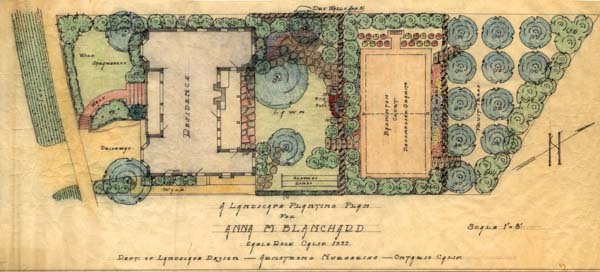
The 1939 landscape plan is beautiful, a vellum stock colored from behind. Something English about it, far more orderly than the reality I recall. Armature for ruin to which gardens tend. The plan and plant invoices from Armstrong Nurseries, adjusted right or wrong by several memories, show lawn and flowers (camelias, roses) on the lowest level. The projected badminton court on the middle level never happened. A bench under arbor (painted green) at west faced lawn. A swingset was erected (I remember the day), also a flagpole (remember its raising too); and children’s tent in summers. Lemon and sapote, swiss chard that we ate raw. At the highest level closest to the hill, guava, loquat, peach, two avocado trees, even cherimoya (that I don’t remember, but that my sons love now). Dill there was, but no other spices that I can recall. The levels were terraced by broken sidewalk, sedum in the cracks.
Deer came down to saltlick under one of the avocado. Raccoons visited, and skunks. The yard backed up a culvert, and then to the hill into whose crumbling conglomerate and yucca-spiked trails we hiked. From the hilltop came occasional glimpses of ocean shimmer. People ran twin wires — separated by an inch stick of plastic — all the way up to television antennas along the ridge. (Someone tends bees up there now.)
Memories of pill bugs, trapdoor spiders, snakes. A treehouse (in the lemon tree) and the vaguely Polynesian, vaguely Sunset-magazine inspired structure Victor built hanging out on stilts from the top level, in which we slept some summer nights and woke to hot cocoa he’d bring up. Indeed, we discovered, built and unbuilt a succession of structures, forts, hideouts.
At smaller scale, I bulldozed my own roads when I played city.
Various nomadic cityscapes — nomadic because I’d lose interest in one as an outlying establishment would elaborate itself — took form as I scraped dirt, laid out roadways and settlements, positioned plastic men and metal trucks. Repetitive scraping is the opposite of building up a picture (painting); involves palimpsests, movement at once through space and time. It’s conservative. It was a big part of the freeway construction, in our section, anyway, and has figured as metaphor ever since. Lots of solitary hours. Humming, sub voce narrations, truck noises, exchanges.
Map of Eagle Rock with sections of Annandale and Glendale, E. F. Hill, 1927; from David Rumsey Historical Map Collection
Some of these earthworks were up by the back culvert, border of our property. In summers, earthwork migrated to avocado shade and mulchy soil; next door, a mostly unattended radio by the neighbor’s pool was always on, to KFWB in its pre-news days.
Read, even did arithmetic homework, in the twisted trunk and main branches of that same avocado. Barbeques. Victor’s smoker for the albacore, barracuda, bonita that Roy brought back from his longer deepsea fishing trips. Laundry on the line, out by the roses—sweet and sour.
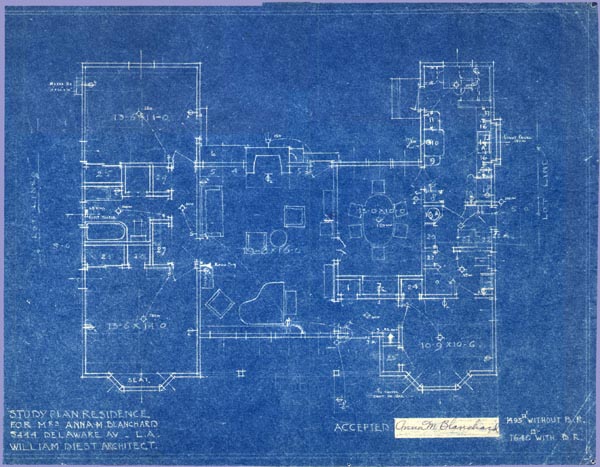
The residence that was built differed from the plan, particularly the dining-living room relationship. We had an upright piano, not the baby grand shown here. Thick (leaded) paint. Parent quarrels. Victor home after Sunday half-days at the store, for a quick nap. A little doorway for the milkman, with a little dial indicating how many quarts to leave; our Carnation milkman didn’t use it. We drew on Sunday classifieds, not on the clean typing paper my sons assume is theirs today. Developed island battlegrounds on chalkboard in the laundry room, erasures for transitions.
The state took the property; my parents took the state’s first offer. (It may involve deference to authority, or some sense that it was too good to be true, anyway..., or better than we deserved...)
The move was to a tract home on the hill opposite us. The Glendale Eastridge
project had gone on for a year or two. I’d watched the scraping and shaping and building from the distance of our front window and the different vantage of my second-grade desk at Saint Dominic’s. Earthmovers were audible when wind was right and attention wandered. Thither we moved, into a two-story, split-level home
on Round Top Drive, the largest lot on the tract though much of it hillside. Hillside wasn’t fill; the house site was carved out of subsoil conglomerate. Landscapers installed a pool-shaped sidewalk surround, separating lawn from a low-maintenance surround of green stuff.
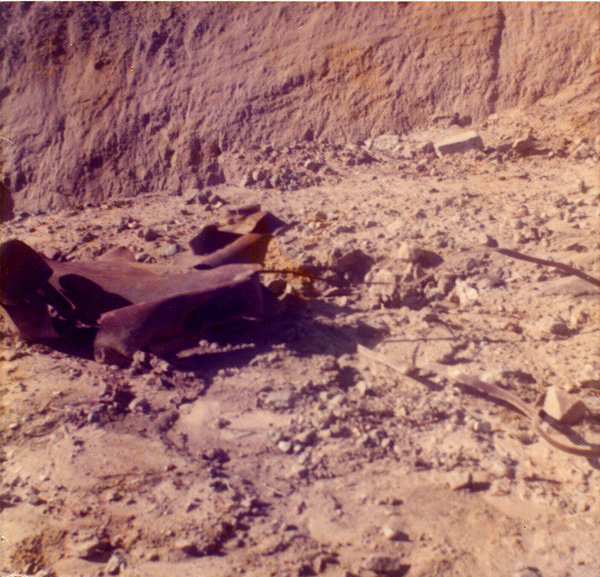
shot with Victor’s old Brownie Box Camera, I think not the 134 but rather the 2.
From our new perch, we could see the old house across the hill, and then its ruins, and at long last the lot’s burial under fill. Houses were demolished, but foundations remained a while — even years? — longer. Someone must have cut trees on our and other lots, avocado and other (what a horrible job!). I suppose that these kinds of projects are, for some in the way, a form of terrorism: willful destruction for a greater good, resulting in dislocation but probably other unforeseen consequences. Construction stalled well into the Jerry Brown years of retrenchment. We sometimes walked over the site. The freeway finally opened in 1971.
By then, I was gone.
Today (late 1980s) freeway activity animates my father’s spectacular view of the mountains from Round Top — the entire front of the San Gabriels, Mount Lowe, Inspiration Point, Mount Wilson, a slope of Baldy and, from upstairs on a clear morning, Gorgonio in the distance. The freeway noise isn’t bad, more like a rustle, a gentle hum that fits into L.A.’s orchestrated drone of air conditioners and pool filter pumps. There’s beauty to the scene, particularly of rush-hour lights. Only Sundays now, down from two or three days a week, Victor goes out through Pasadena to the store. He used to drive 134, but it’s too fast for him now; in any event, he prefers the life-long familiarity of Del Mar or California, passing Cal Tech on the way. (This has since changed, the store and Victor are both gone.)
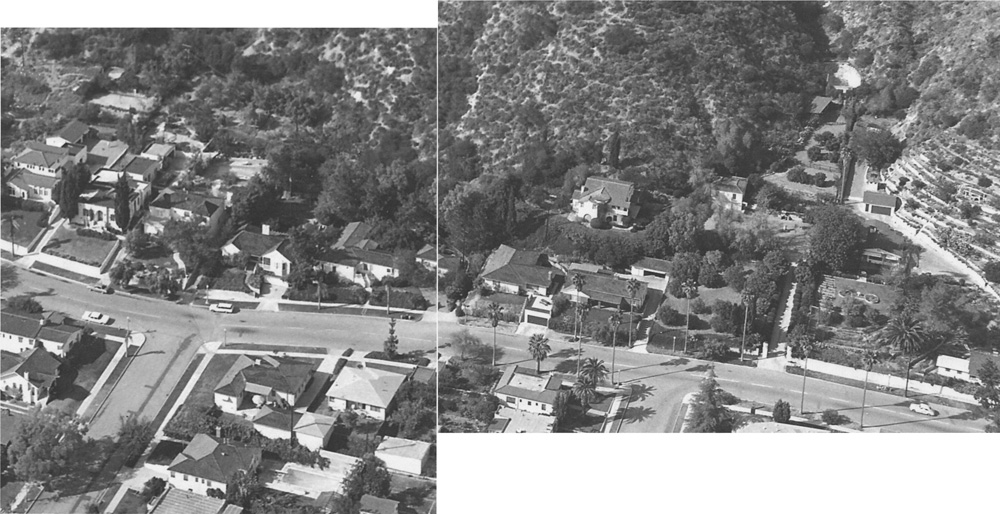
two LAFD (?) aerial views, combined. Circa 1960.
The house with the white station wagon in front is 2779. This is the only photograph that shows the whole facade of the building, alas. I see now that Hill Drive was routed to avoid cutting through ridges of the hill; hence, some homes had very deep lots running from the street back into the canyons. The line of darker blacktop running up the right side of El Verano recalls to me the work that was done there, smell of asphalt, workmen digging, even some kind of exchange with them.
To the left would have been the Smaldinos (Michele Smaldino, 2801 Hill Drive), Wolcotts (Everett S, at 2807 Hill Drive) and the Pruitts (Henry C, at 2811 Hill Drive). I played with Richard Wolcott and Johnny Pruitt. The Wolcotts had a solarium — an echo-y, sunroofed room in which Richard’s mother (and aunt?) would lounge. I remember (and regret to this day) tossing a rock down the hill, that hit Johnny. At the right (east) corner of Hill Drive and El Verano were the Morses (Phillip C, at 2772 Hill Drive). Japanese gardeners tended their lawn and hedges; Mr and Mrs. Morse owned Morse Variety Store, at 2118 Colorado (just east of Eagle Rock Blvd.), where we kids from St Dominics would stop to get candy, under Mr Morse’s watchful eye.
The imposing house up the hill in the right photograph is something of a mystery. I remember the long steep driveway, a pond, and seem to remember there’d been stables there; the terraced gardens further to the right may be part of the same estate. The house was reputed to have been the home of a western movie star, possibly Tom Mix. The sidewalk was interrupted before that property: it was a dirt path through some form of succulent ground cover; those were cork trees in front.
San Rafael School, where I went to kindergarten and half of first grade, is gone too, though some of its old chainlink fence stands now, 40 years of more rust later, behind Ernie Junior’s Taco House.
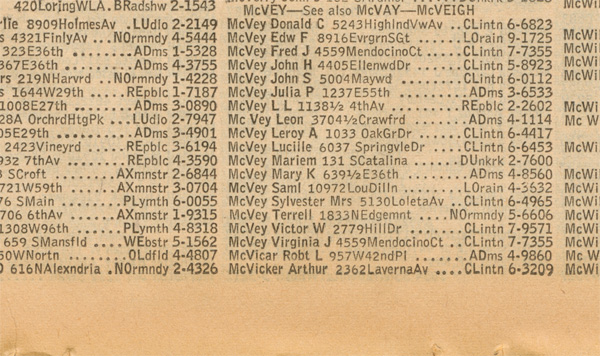
ex Los Angeles Exchange Telephone Directory (Central Section of the Los Angeles Extended Area), June 1959
Our McVeys are: John S (Steve), Leroy A(rden), and Victor W.
Connected with that house and the intrusion of the 134, in my recollections anyway, are other developments — my mother’s slide into cancerous decline, through a 1963 operation in New York, where she lost her hearing, to her death in early 1969; the move of Victor’s store from westside Culver City to family-valued
Temple City at about the same time as our own move; the purchase of new furniture and art for the walls; my own withdrawal into literature and attitude.
We couldn’t have been at 2779 for more than five years or so, but it inhabits an outsized part of my memory. By separating me from that house and yard, the 134 vignetted the experience, framed it as lost and made of it an eden that perhaps today I seek to honor in the garden on-going at the side of our three-unit condo.
Victor lost another property to the freeway, to the Foothill (210) extension — if it can be called that. Two rental units, out in Pasadena north of Walnut. I remember the place, a walnut tree in front. The nineteenth century lingered in the neighborhood. When one of the tenants, a Mrs Foster, died, Victor had to empty the unit. I needed to be there that day, presumably a Wednesday — his day off, perhaps during the year I missed 90 days of school for an allergy — and remember getting a bunch of dimes she’d saved, for my pains.
Los Angeles freeways afford a choice: freeway or surface. To take one or the other has a meaning that wouldn’t be there, if the option wasn’t available. I chose to take one of those freeways out of town, and have lived away (Berkeley, Jakarta, Tokyo now Cambridge and turning east, to Europe) ever since. People — some who’ve never been there — say L.A. has changed. They seem to mean the traffic, the ethnicities. But the freeway’s never always been the fast route, and viva the variety. Los Angeles has always been in flux. What matters most isn’t gone — the mountains and the sense of back-country escape they represent, the air and light, the counterintuitive trajectories one might explore in getting from point A to point B.
avocado trees (addition, June 2014) —
There were two avocado trees in the back yard, long since erased. Both produced, and at different times of the year.
The one remembered best: complicated, its trunk meandered up into several stages or knots of thick branches, solid enough to hold three children who, their respective perches secured by limb wrapped round limb, did sums and (in my case) doodles in their arithmetic workbooks, or the like.
There was a certain roughness in the bark, pleasant to recall. Smells. Dappled shade.
From the same trunk, another main branch arched out and down, to create a room, greenleaf ceiling, fallen brownleaf floor. Salt lick at one corner, that brought deer in from the hills some mornings.
I remember its taste.
cities
As a boy, I made cities in the dirt behind my house... We laid out roads, parking lots...
On his youth not in Eagle Rock but Lakewood. D. J. Waldie, Holy Land, A Suburban Memoir. New York & London: Norton, 2001: 131
Best parts of the book are about water, aquifers, the threatening saline plume...
eagle rock links
- Eagle Rock’s Freeway Revolt at Walk Eagle Rock, posted March 23, 2015
interesting account of the politics and passions in the late 1950s early 1960s. - A discussion of the Colorado Freeway that took 2779 Hill Drive, and many other homes up against the hill. It’s part of Historical Highways of Central and Southern California / US 6 and US 99, assembled by Michael Ballard.
- Jean Won,
Eagle Rock: Community Pride Through Triumphs and Tribulations
(2002), which can now be found via the Eagle Rock Historical Society links page, and the document page here; skip the chapter links (which don't work), and download pdf at top right. It's informative, includes bibliography. See also Jan Lin and Jean Won, theirThe Arroyo Seco and Highland Park, A Community History
(2002), no longer available online. Jan Lin is a sociologist at Occidental College. www.bob-taylor.com/eagle-rk.htm Eagle Rock history - Dave Gardetta’s
Mayberry, Shmayberry,
a 3,962-word essay in the L.A. Times Magazine of 29 July 01, covers demographic changes here:Eagle Rock lies poised to be the next Hot Place. That could spell big changes for a retail wasteland with a distinct inferiority complex. It could also mean the end of affordable bungalows, an eclectic population and many small-town moments.
Can be accessed via the L A Times archives. - Post-fashion — When the Next Wave Wipes Out. Treats impact of recession on Eagle Rock’s "discovery" by coolistas —
What happens to bourgeois bohemia when the bourgeois part drops out?.
New York Times, 26 February 2009 - my Eagle Rock water story (2011), at my defunct catatan blog. It is a response to Jane Tsong's beautiful web essay, Myriad Unnamed Streams — on water stories in Northeast Los Angeles.
- TERA (The Eagle Rock Association)
- Eagle Rock Historical Society
Useful links include photo collection at LA Public Library. SearchEagle Rock
in thephoto collection.
These ruminations are adapted from my posting to Jeff Gates’s In Our Path website in the context of the impact of freeways on the community, now removed to www.outtacontext.com/iop. I haven’t — but should — entirely recast them, outside of the freeway construction framework.
1997; 2003; jan 2008; feb 2009; apr 2010; jun 2014 march 2016