putterings 588 < 589 > 590 index
Especially when complicated by a puttering husband
19
How then could any puttering carpentry of mine
Be rewarded with anything
But failure?
270
Squeezing words.
God!
One hour, two, an afternoon;
One labored sentence forced on paper.
A week, a month, six months
And I still puttering with the sickening events of “A Play by Scholom Asch.”
272
And I won’t take a puttering, part-time job;
My inferiority must once for all be dealt with.
For a year or two,
Maybe for three years
I'll devote myself to making money.
359
—
all from Percy Shostac, 14th Street : A Novel in Verse. Illustrated by Kurt Wiese (New York: Simon and Schuster, 1930)
U Illinois at Urbana-Champaign copy/scan (via hathitrust) : catalog record : link

reviews of 14th Street
Percy Shostac (1892-1968)
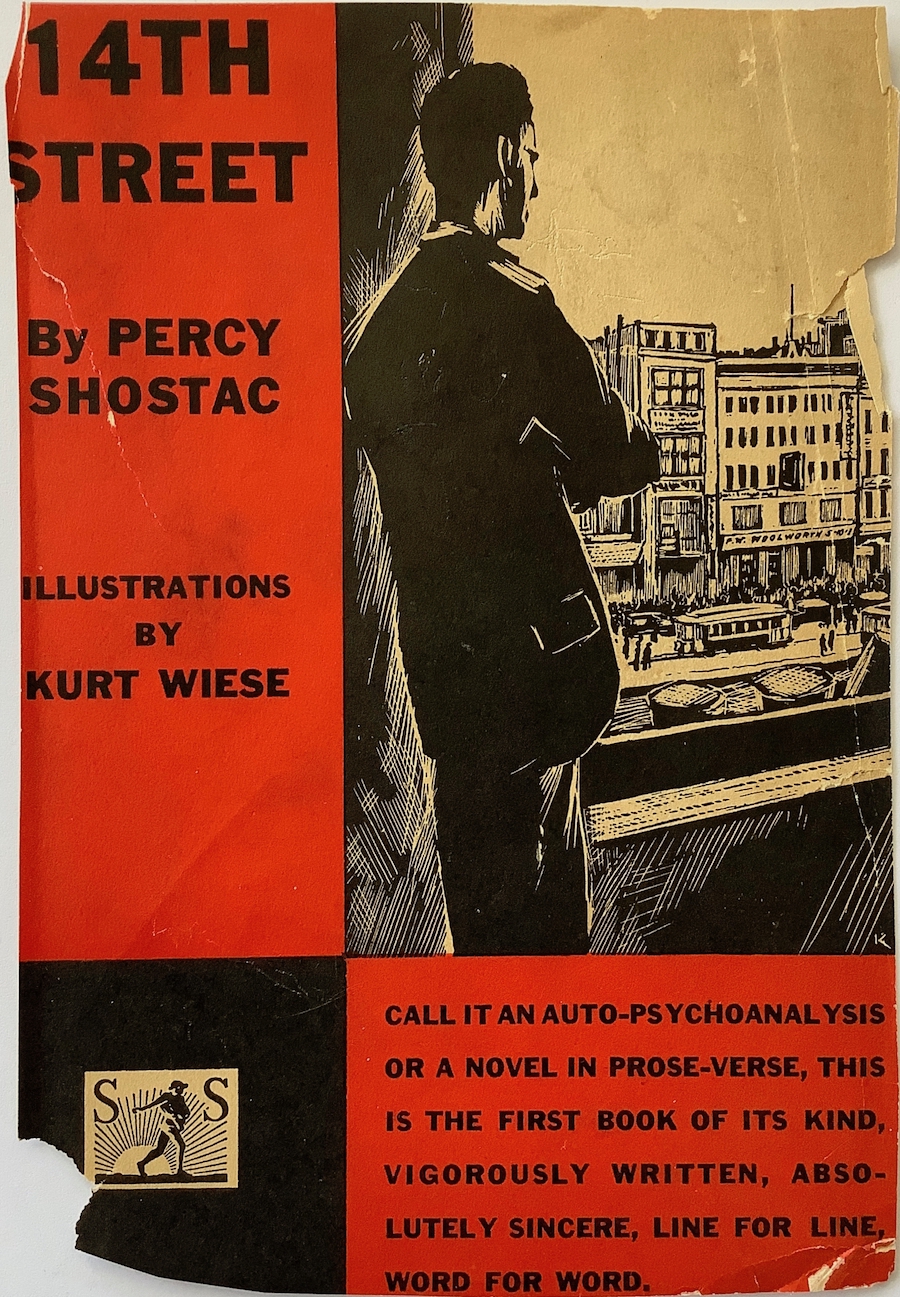
dust jacket, trimmed (as found in copy of book at hand)
found on the front (or back?) flap of the jacket (above “Price, $2.50”) :
This is one of the most unusual novels the publishers have ever encountered. Briefly, it might be summed up as an auto-psychoanalysis. reviews and other mentions of 14th Street
The Times reviewer, like others, attempts to pigeonhole a novel he (she?) doesn’t know quite what to do with. (The publisher’s promotional language does the novel no service, perhaps.) Here is the review, in toto :
That a novel may be in another medium than prose is of course not an original notion. But it is one rarely put into practice. Recently there appeared what purported to be a novel, but done in a series of woodcuts. The expressive alternative to prose being, however, verse, that medium, rather than the illustrator’s art, would seem to be the more natural one adopted by those wishing to be different. And verse, of a kind, is Percy Shostac's vehicle for carrying forward the narrative the author calls “14th Street.” Poetic Autobiography I’m cracking no bromidium for laugh Percy Shostac, 27, a Russian East-Side Jew, onetime instructor in English, is by profession a stage-manager. He writes plays on the side, “pretty heavy stuff laid in the Middle Ages.” He fell in love with a 30-year-old married woman, living in a New Jersey suburb. Small (5 ft., 6 in.) but fiery, he persuaded her to leave her husband, come live with him on 14th St. When their money ran out, disillusion began to set in. She left him, went back to her husband. He set to work to exorcise her magic by writing this record of their love-affair, his subsequent adventures as stage-manager, playwright, carpenter, bohemian. His intensity, his uncompromising honesty have saved his subject from being either offensive or uninteresting.
Fiction in verse is not the novelty which the publishers of 14th Street by Percey Shostac (Simon and Schuster, $2.50) would have us believe. So far as we know, the first stories in the world were told by poets. We are too little a student of free verse to say whether Mr. Shostac’s book is poetry or prose set up in uneven lines. But Mr. Shostac has at least one of the qualities of a poet. He lives in and writes of and from emotion, exclusively. His book is, presumably, autobiographical, and tells the simple story of a Jewish boy, a dweller in New York’s Bohemia, who loved a married lady and lost her to her husband. Deserted by her, he cannot understand why she has left him and cannot forget her. He tells, first, the history of their love affair, and then analyzes the reasons for its ending in terms of his knowledge of life, especially sex-life, work and his race. The world seems to be made up of two kinds of people: those who think that every one who does not live as they do is “inhibited,” and those who think that every one who does not live as they do is immoral. Mr. Shostac belongs to the first group. He attributes what may very well have been some good sense and a lot of indifference to the Puritan complex or the Victorian inhibition. He has nothing new to say on any of the many subjects which he discusses. Even his conception of the Jew as surviving because of his masochism is held and has been expressed by others. But what he has to say is honestly said, and sincerity illumines his otherwise pretty dull pages. And its sincerity may give 14th Street a value in the eyes of the many readers who always confuse the human document with the work of art. But the value will be a false one. This common current attribution of artistic importance to the out-pourings of self-analysis with which hordes of writers (and many of them are young Jews) deluge us has resulted in a breaking-down of critical standards, here. The human document, per se, is not art. If it becomes so, it is because it is the work of an artist. And, although the inspiration and the expression must be entirely sincere, sincerity is not likely to be the most conspicuous characteristic of the finished work. “Maybe through saying it,” writes Mr. Shostac, in his introductory chapter (canto?), 14th Street A phrase like “Energized the inaction of my frustration,” shows how grossly misinterpreted a notion may become. Percy B. Shostac (1892-1968)
Gertz first discusses the likely author, Val Lewton (Vladimir Ivan Leventon (1904-?), and then gets to Shostac in a quite thorough survey, including his authorship of some pieces, and publishing of several titles, not otherwise listed on this page.
Fellow New Yorker Percy Shostac, who won UW’s first Menorah essay contest, went on to write an experimental novel-in-verse called 14th Street, in which he referenced his Jewish background and bachelor’s and master’s degrees from the University of Wisconsin.
a scan of the novel — minus its title page — is found at archive.org : link Christian Wahnschaffe, roman ... von Jakob Wassermann ... Jakob Wassermann (1873-1934), “German writer and novelist” the google reference wrongly suggests a different author : Jacob Wasserman (1880-1942), for whom the LoC catalog lists three items : link
Homer G. Thomas, The prodigal version [probably The Prodigal Virgin]. Illustrated by Jaques Merd [d.i. William Bernhard]. another might be The Abduction of Edith Martin, Picture a factory where ancient ship-timbers and driftwood are converted into tables and lamps, and you’ve described a newcomer to Washington industry. 26 February 2026
The author begins by telling the reader who he is, what he looks like, and what he has seen. He then proceeds with a sincere account of a love affair — from its romantic beginning to its rather unfortunate end. Here the first half of the book ends.
The author cannot rid himself of the memory of the girl. He therefore sets out deliberately to discover what it was that made her leave him. At this point the book is divided into four sections : Sex, Work, Money, Race. The author discovers for himself that these forces operate on his life. The reader will inevitably find himself identified with the author, for these are universal variations and sidelights on the theme of love and life.
Quite frankly, the publishers cannot predict the permanent literary value, per se, of the book. It is vigorously written, absolutely sincere, real and interesting, line for line, word for word.
via archive.org : link
Leaving aside for the moment the matter of the verse. it is still a question, though on other grounds; whether “14th Street” is a novel. Perhaps it is autobiography. The publishers sum the book up as "auto-psychoanalysis," whatever that may be. One half the volume is devoted to a faintly sketched narrative; the second half is utilized by the author in analyzing himself during the time that he was — or imagines himself to have been — the principal actor of the preceeding episodes. But whatever the book may be, the more important question is that of its success or failure as an important reading of life, the ultimate test, except of stylistic aspects, of every written document, whether real or imaginary, seeking to engage the attention of a reader.
It is easy to perceive that many a reader, especially the reader of adolescent years, will fancy he finds in “14th Street” something at least fairly important. Yet, as if in proof of how rapidly interests change, Mr. Shostac’s novel (we shall so designate it) would have seemed much more important a few years back than it possibly can today, irrespective of a reader’s years. “14th Street” belongs generically, to about the period of Dos Passos’s “Manhattan Transfer,” or “West of the Water Tower,” when sex was the major preoccupation of the novelists. That sex will always be the mainspring of fiction is probable, but the period has largely passed of what might, for lack of a better term, be called the pseudo-scientific interest in its manifestations. In its position in the literary procession, therefore, Mr. Shostac’s story appears as an après-midi d’un faun.
We shall not retell the narrative, not merely because it can readily be guessed at as belonging in the category of triangular love tales, but because the analysis rather than the narrative is the true centre of interest. The book must rise or fall on the analyses made by its author.
The lover of “14th Street” is represented as a young Jew, the wife and husband of the story are Gentiles. The lover also is represented as being abjectly poor, and as a visionary with harassing literary ambitions. Thus, there are four powerful forces which have operated on his life, namely, sex, work, money and race. (We use the past tense since the analyses are supposed to be made after the love episode has terminated.)
We pass over the first inspection. enough having already been said concerning the place of sex in the book. The analysis is uncompromising, but always conducted with reticence. There is little of fresh contribution to the subject. “Work” is well epitomized by the episode of the table which the young man is represented as making for a neighbor. The lumber has cost more than the neighbor has paid, but the amateur carpenter has found so much pure joy in his work, has wrought the object out of his own inner self to such a degree, that when the purchaser murmurs criticism of the size, he flings back the money and lugs his lowly dream-child to his own rooms.
I’ll keep it here in the hall to look at,
Or rent a room for it,
Or give it away to some one
Who thinks what I do of it.
The discussion of Jews and Jewry is the portion of the book which has real importance. The author neither apologizes nor arrogates, but calmly discusses what the race has contributed of richness in his life, and of the reverse. Mr. Shostac’s “14th Street” is, clearly, a book not of the ordinary run of fiction. Whether it is a tour de force, or is concealed autobiography one cannot say; nor is the question important. As poetry the book is not noteworthy. Indeed, the narrative is in broken prose rather than in fluent verse. The volume is over-long; the whole thing could have been done in fewer lines. The illustrations by Kurt Weise are interesting.
via archive.org : link
Poet Shostac has less to say about Manhattan’s 14th St. than about himself. He writes this segment of autobiography in unrhymed, uneven lines that read well and easily. Not particularly quotable, never reaching a high poetic plane, never distinguishing between the vocabulary of poetry & prose, his novel in verse has considerable cumulative effect.
When I say
That woman’s place is in the home.
Is this thing called motherhood a bunk?
Are men mothers?
Bah to your equality,
To your sameness of man and woman.
Is a rooster the same as a hen?
Lucy Stoners look to your anatomy.
“The mess in me can be mopped up.
Maybe by telling it
I can purge myself.”
Many people nowadays purge themselves in this particular way. They are at liberty to write. You are at liberty not to read, if you do not care to assist at an extremely private operation which, we believe, has been performed in public only by certain seventeenth century kings.
describing it as a “psychoanalytical study presented in free verse with sincerity and feeling.”
via LoC Chronicling America : link
Just why books like “14th Street” by Percy Shostac (Simon and Schuster) are written this reviewer will not attempt to guess. This novel, entirely written in prose-verse, is said to be an auto-psychoanalysis and the first of its kind. Let us hope it is also the last.
Shostac is, by his own account, a Russian Jew born on the East side of New York, the sort of a Jew, one gathers, who would be classified as an Intellectual, but who finds contact with other intellectuals extremely difficult if not downright impossible.
His prose-verse deals with an over whelming love affair which comes to him with a married woman of 30 (older than himself) and with the psychological reactions caused by her ultimate return to her husband.
Some of the later chapters deal with work and racial problems, but
there is a constant reiteration of the love-theme and a repeated attempt to find out why one woman should; make or break a man’s career.
If “getting it off one’s chest” can cure a complex such as Shostac admits as an aftermath of his infatuation for a New England school teacher, Shostac must be thoroughly cured now. The great wonder is that Simon and Schuster, who seldom blunder into anything of this sort, should have been induced to assist in the auto-psychoanalysis experiment.
jstor : permalink
Grushenka : The Story Behind A Rare Classic Erotic Book (September 9, 2013) : link (accessed 20260226)
link (acccessed 20260219)
LoC : permalink
LoC : permalink
via search result : link
from its copyright page :
The title of this novel in the original is “Christian Wahnschaffe.”
The title adopted for this translation has been approved by the author.
Copyright, 1920, by Harcourt, Brace and Company, Inc. // One volume edition, 1930.
By: Wassermann, Jakob, 1873-1934
Published: S. Fischer, Berlin-Wien, 1919
LoC : permalink
wikipedia : link
Published by Dijon, France, ohne Verlag [d.i. New York, Percy Shostac], 1935.
Antiquariat Ars Amandi, Berlin, Germany, via AbeBooks : link
(accessed 20260220)
item 6075, described at
Patrick J. Kearney, Notes towards a Bibliography of the Brandon House Library Editions (Santa Rosa, California, 2019) : link
(accessed 20260220)
One-Man Factory Produces Lamps And Tables Made From Exotic Woods
By Truman R. Temple, Star Staff Reporter
The Evening Star (Washington, D.C.; October 19, 1960)
via LoC Chronicling America : link
It thrives on breaking all the rules of 20th century industrialism. It has no labor relations department because the owner. Percy Shostac, is its one-man assembly line.
It doesn’t need to worry about proper flow of parts; the Potomac, the Chesapeake Bay and old shipyards yield a mountainous supply of raw materials. And since the output moves at the leisurely pace of three lamps a week, one table every six weeks, mass production worries are missing.
Mr. Shostac recently opened his factory and showrooms at 1833 Wisconsin avenue N.W. in Georgetown, under the title of Heritage Tree Lamps. As a
concession to modern public relations theory he does permit customers to inspect his inventory — a pile of gnarled tree limbs and stumps.
38 Varieties of Wood
from the rivers and shores of America including cypress, oak, cedar and even grape vine roots have been altered by Mr. Shostac into objects for the living room. Over the years he’s put more than 30 different varieties of wood to use.
The owner’s constant search for new sources of wood has led him into strange corners. Once while scrounging through an old lumber yard he found a treasure of blackened timbers that had been dredged from the bottom of Boston harbor.
Years ago shipbuilders used to season oak by leaving it in salt water, and in this case the builder had vanished, leaving a submerged hazard to shipping. After the Navy hauled the timbers up, sawmill operators found the wood so hardened and full of iodine and salt that they abandoned them as useless. In Mr. Shostac’s hands, the oak became coffee tables with a rich, satisfying glow.
Dogwood Windfall
Another find was a discarded store of dogwood that had been ordered during World War II to make shuttles for looms in an upstate New York textile mill. When the war ended and the order was cancelled, Mr. Shostac bought them dirt cheap. He considered it a double windfall because most States prohibit cutting dogwood. a measure to keep tourists from breaking off their boughs in the springtime.
His latest excursion into the wood market has uncovered an industry as rare as his own: whaling boats. Mr. Shostac found an old sawmill in Allendale, N. J. that was cutting up white oak trees to supply builders of the boats in Iceland. For some reason Icelanders prefer wood to steel for their vessels.
“I had to make several visits to persuade the mill people I wasn’t a screwball,” he explains, "but we’re good friends now and they put aside the cuts I need for tables.”
Hard to Identify
A list of the woods he has secured from various regions would include manzanita from the Rockies, cypress and buttonwood from Florida swamps, and birch driftwood from Vermont lakes and streams. Driftwood is hard to identify, and he calls up the United States Forest Service when he’s stumped.
Probably the most bizarre table he ever made came from an oak that had been struck by lightning. “It took two men to haul the stump into the shop where I could work on it.” he recalls. “I hewed it into shape with an old-fashioned adz. That’s the last time I ever want to swing one of those things. But the table made an evocative conversation piece.”
Scholar and Author
Mr. Shostac’s elegant use of language is no accident. A soft-spoken and scholarly man, he holds a Master’s degree in English literature from the University of Wisconsin and once wrote a novel, “Fourteenth Street,” now out of print.
The owner started out with a boyhood love of wood as a pupil. in the Ethical Culture School in New York. He was earning his first money at the age of 12, producing cabinets and shelves for friends, and intended to become an engineer
specializing in wood construction. He wound up a stage manager in New York, however, although his hobby of converting burls into lamps kept haunting him.
About 10 years ago he gave in to his lifelong fascination for the lines of tree limbs and opened shop in New York. Since then he’s made and sold more than 1.000 lamps and perhaps 50 tables. He moved here this year, in his words, “to get [away from the Manhattan rat ?] race.”
Artiat and Artisan
His technique combines both carpentry and the art of arranging branches and plants. “When you get rough driftwood, it has no grain and it’s usually just an unidentifiable mass covered with mud,” he explains. “Clean lines and planes are necessary, and chiseling away decayed areas, sanding and polishing bring out the wood’s sculptural beauty.”
After the piece has been waxed and its grain brought to life, there still remains the job of displaying its form to bestadvantage. This is where the artist’s skill takes over from the artisan’s. The visitor to his shop will find highly polished
wooden shapes, some suggesting a dancer’s legs or a unicorn’s head, but most are pure abstractions.
What kind of people buy driftwood lamps? Mr. Shostac has sold them to [policemen ?], sheet iron workers and financiers. In fact, one customer was a manufacturer of driftwood lamps. “I produce them by the thousands on an assembly line, but the stuff is junk,” he confided to Mr. Shostac. “I want this one for my own livingroom.”