Anne Ryan, available writings
Below is a directory of writings by Anne Ryan (1889-1954), known most as a visual artist, and especially for her collages. A few other sources are also listed.
writings
translations
visual work
about
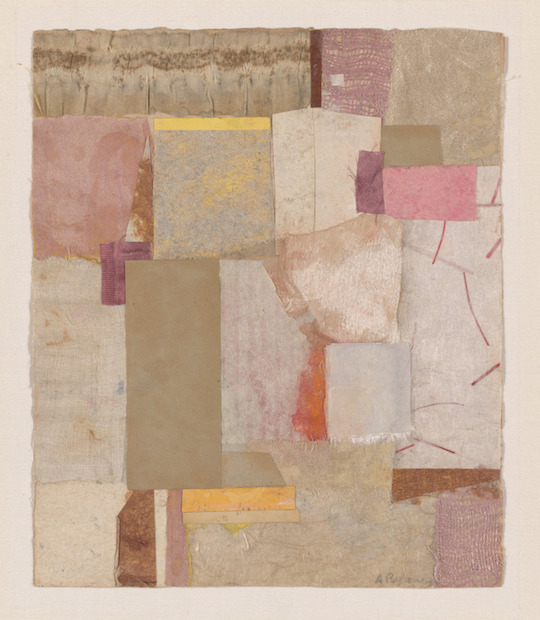
It was a post of Anne Ryan’s collage “Number 62” (1948) — shown above — at thingsmagazine.tumblr (April 27, 2026)
itself taken from and pointing to MOMA
that led me to her wikipedia page, and this passage about those collages from Deborah Solomon, in her 1989 essay (linked below) —
“she recognized the visual equivalent of her sonnets — discrete images packed together in an extremely compressed space.”
It was the poetry/collage connection that interested me; piqued further by the scant attention paid to her writing, and to the Roman Catholic dimension of much of that writing.
This list is assembled for personal convenience. No claim is made that it is complete; it remains in progress. A few pieces are (or likely will be) transcribed in part or whole, again, for personal reasons. Transcriptions may be included on this page, or (if of longer texts) located at separate pages.

writings
- Lost Hills — poetry
(The New Door; 4 Christopher Street, New York, 1925)
google books : link—
reviewed (under the head “briefer mention”) in The Commonweal 3:26 (May 5, 1926) : 726
via hathitrust : link
via archive.org : linkThis little book of Impressions and Portraits reveals in the author a natural gift of vision and character quite without the attitude of the professional poet or the aroma of the studio. The Impressions are evidently derived directly from nature, expressed in a harmonious Celtic style and animated by a lofty sense of the beauty of creation. There is religion here also, not obviously approached but rather sensed in the quality of the appreciation. The Portraits are stronger, and more interesting in character than in merely aesthetical quality. Old age and renunciations are favorite subjects of Miss Ryan. The final lines of her poem, From a Spinster, reveal the general scope of The Lost Hills:
“So cloistered, locked away my real self lies,
In days grown ordered and austere.
The peace of age,
The freedom from worn-edged domination,
The quiet dusk dream —
Are so safely mine.
And now, in a moment, I’ll go in to supper, frugal, solitary —
Contentment in its accustomed groove;
While before me, through the darkening halls of, this old house,
The little breeze will carry
All the salt, the tang, the freshness of the sea!”There is a soft, feminine quality about the poems of Lost Hills which sometimes slips into a misty lack of thought that suddenly startles the reader to question the intent of the poet. A slightly firmer handling of her subjects would place Anne Ryan in an enviable position among the singers of today. There is reason to expect that she will yet acquire it.
—
reviewed in Poetry, A Magazine of Verse 30:5 (August 1927) : 294
via archive.org : linkLost Hills, by Anne Ryan. The New Door, New York.
A desirable directness and austerity contends in this book with too rigid metrics and a tendency to moralize. For example, the blank verse of the title poem is too solidly five-footed, the rhythm never carrying over; and the final stanza is an informative appendage to the poem. This is a pity, for it gives us a vivid study of a character pathetically thwarted and futile in its love of beauty.
Miss Ryan’s rhythmic instinct, uncertain in metrics, is still less to be trusted in free verse. - “Two Churches with Carvings.” [Whippany, and South Orange]
The Commonweal 15:1 (November 4, 1931) : 17-18
archive.org : link - “The Symbol.” [verse] The Commonweal 15:8 (December 23, 1931) : 206
archive.org : link - “Mass at Palma.” The Commonweal 15:19 (March 9, 1932) : 521-522
archive.org : link - “Junípero Serra.” The Commonweal 16.12 (July 20, 1932) : 309-310
archive.org : link
transcription : 2953_ryan-junipero-serra - “Outside of Rome.” The Commonweal 16:21 (September 21, 1932) : 489-490
archive.org : link - “San Bernardino.” The Commonweal 17.4 (November 23, 1932) : 101-102
archive.org : link
- “Tyrol Christmas.” [verse] The Commonweal 23:8 (December 20, 1935) : 208
archive.org : link
transcription below (move to separate page?)Tyrol Christmas
Not like any other night is this!
It is black, crêpy black
In the room
Where the mother’s heavy hand rouses children in the gloom
Of their dark enormous bed,
And her candle’s light is spread
Along the rafters as she goes
To the cattle in the stall
Just beyond the smoky wall
Of her kitchen.
And the door
Opens more,
Creaking on its iron hinge
Near the beasts.
Then the children hear the hoofs’ little fall
In the house. . . .
In their house.
Not like any other night,
For the warm earthy house is awake and astir,
And the sleigh standing there before the white
Frosted panes
Has its bells in a whir
Of dancing sound.
The children do not speak,
Huddled under thick fur
On the straw of the sleigh
And they creep, and they creep, and they creep
To make place for their mother.
The bells run bright and faint
From the last clanking door,
Round and round, round and round,
Through the turns and the bends
By the crests and the fens
And the road running over iced bridges.
In the low sky the magnified stars
Shaft the cold black with gold bars
That reach from the heights to the manger.
And the space by the church is alive
With the bells and the lamps in between
The gnarled trees,
And the sheen
From the vapor of so many moving
Gives the vision of flown gauzy wings
Of a low floating swings
Of heavenly robes through the branches;
As through down a black stair,
Like globes in black air
Of vanishing light
All the angels
Melt and return
Tangle and burn
Through, the stark brittle twigs of the forest.
From the sharp, stone house by the river
The charity house by the river
Walks slowly, one after the other
The poor of this place.
Three women, old and how muffled,
Safe and unruffled,
Waiting in age.
They are first through the oaken, arched doorway,
With their thick candle’s glow on their faces,
And their stiff hands slow at the places
Where the iron sconce for the tapers bracket the ends of the benches.
And the children gaze at the manger.
Straight and unveiled is the mother,
White as a reed, unafraid.
They see the figures of oxen
Look over a mossy wall
To warm with their patient breathing
The chill enswaddled One.
They see straw that is crisp as the new bed,
So slippery and yellow that their mother had spread
In the house for those beasts of their own —
And they think
“Not so different, not so far.”
All this in the midnight forest —
The children, the three poor women,
The blown candles like small flags unfurled,
The rugged voice singing, singing,
All this in the midnight forest
Wrapped in the midnight forest
Of the world.
- “Mary Salome, Widow.” [verse], in Spirit [“A Magazine of Verse; The Catholic Poetry Society of America”] 3:3 (July 1936) : 84
archive.org : linkfound also in Joyce Kilmer’s Anthology of Catholic Poets (1917, 1926; 1937) : 381-382
borrowable at archive.org : link
transcriptions below (move to separate page?)Mary Salome, Widow
With your head-cloth knotted and your shawl pinned tight
You come out of your house this day and close the silent door.
You are alone,
Your life has faded.
The misery of your youth,
The lost abundance of your love,
And those nights in which the name, Salome, was given you,
The waste and the murders and the chaos of your village, long ago settled by Cesar,
All have drifted away like a mist of tales which encircle
Another woman unknown to you.
It is not yet light.
Along the road the cypress, fluted in black,
Stand mourning still.
You carry your cup of ointment carefully nested in folds,
A neighbor, hurrying, grieving for the flogged, dishonored Dead.
Later: In the chapel of Dona Maria Forteza
They have given you a niche of silver
With a canopy strange and chirrugeresque,
While for your office, your name —
Always like the ringing of two bells —
Is displayed forever
Between figures from the Calvary
And a fragment of the Resurrection.—
“In Mark 15:40–41, Salome is named as one of the women present at the crucifixion who also ministered to Jesus...”
wikipedia : link
- “Perfumeria.” The Commonweal 28.2 (May 6, 1938) : 44
archive.org : link
transcription : 2953_ryan-perfumeria
- Four poems appeared in Voices [“A Quarterly of Poetry”] 119 (Autumn 1944) :
“Autumn” p26; “There Is No Prime” pp26-27; “Lines to a Young Painter” p27; “Manhattan” p 28
transcriptions below (move to separate page?)Autumn
This time of secrecy,
Of winds blowing with color and the turning line of walls,
Of the gaze fastened on another land, hidden deeply,
Is here now
The tired face of girls
With the black and white blur of days
Fastening its tooth in the orb
Of their lives
Is still the distant landscape
Where can rise
Ordered and terrible dreams.
Some little monument stands at each corner
And thoughts are like paper swirling in the street —
Yet a voice, lost in voices, in the midst of stone,
Sings to me.—
There Is No Prime
There is no prime,
The day ascends hour into hour
And climax is battered and unrecognizable.
At noon the children run through the streets wild with life
Or a woman looks from a window and her rooms
Stretch our black behind her
Like the years wherein she lived to womanhood.
In the night the rubbish fires burn on the icy pavements
And the trucks stop.
Angel,
Can you not tell us one thing more?
Is it so easy to give back the hours marked in their single boxes,
Or the seasons turning into the one ahead?
The dead twitter; the living do not speak.
Yet any word is better,
We can rely on words or defend ourselves against them,
Particularly those rising out of the night
Like a fume, like choking smoke
When death sits on the edge of the bed
And holds long conversations,
And wakes us to listen.
Even this is not sadness.
It is only that the aimless are better prepared for their days;
While for us, with eyes and a mouth,
Suddenly out of nowhere
The unknown currents will form again,
And purpose will rise
And compel us beyond our wills.—
Lines to a Young Painter
The eye, folded and primsmatic eye is there;
For more with sight than any other sense
Is death put off
And daily greeted jocosely.
The yellow sun at Arles
In one roused glance
Poured over the ocher wall and stayed yellow
Because the eye records, blesses, is warm, sharp and fervent.
Color is yours and the wit of color.
The unknown layer on the palette
Plus the far whirligig of cities or waste
Which you shall meet
Spins into the distance.
And that stretch of poverty which you shall perform,
Singly, like another Saint Francis,
Shall be the cobalt and carmine pointing from a small stiff brush.
There cannot be told how to put down a memory in curves or paint,
The wheat growing close to the edge of the white sea,
Fragile, holding its own kernel of death
Amid fragrant storms
Is permanent, only under your hand.—
Manhattan
Seasons are gone from this place
Battered into one interval.
The gilt of spring wastes in its own haze
And autumn, without its former burning,
Flattens against the walls.
In the night walking about the streets
A new astronomy sets sparsely in the sliced black.
Old constallations with their ancient names
Do not turn on their ordered pivots here
But on some tower fastened into the sky.
And if the shade of a tree at noontime
Fall on us for an instant,
Without ceasing to hurry, we are sure
Its poor branches can only enclose a monument,
Where the leaf is stone,
And the wreath is bronze.
- “Fear.” Botteghe Oscure 10 (1952) : 295-302
archive.org : link
transcription : 2953_ryan-fear- “She Was Divorced.” Folder 1:2 (1954) : unnumbered pages, but 23-26 of pdf
archive.org : link
transcription : 2953_ryan-divorced- “Ludvica.” The Paris Review 5 (Spring 1954) : 116-121
archive.org : link
transcription : 2953_ryan-ludvicalast days of the servant girl Ludvica in the house of Mrs Glemby and her husband, a leather merchant. Vica takes comfort in memory of her home, “distant and lost...,” and in the sagas of her country... Odin —
“The old words soothed her, leaped at her, seemed a new cover for her, fragile and deeply past. That was what she sang and remembered.”
- “The Darkest Leaf.” Botteghe Oscure 22 (1958) : 272-306
archive.org : link
transcription : 2953_ryan-darkest-leafhaunting, this story; prodigal daughter returns, but a Mary Magdalen aspect too. the story is set in Pattendale, a mountain town.
dramatis personae :
John Wilton, 80, a retired and widowed farmer — “his own usefulness... gone now” — seeks to bring his daughter Jessie Wilton, full of life and yearning, back from Stroudsburg, “the next big town on the border of Pennsylvania;”
Jesse remains there for a time with her lover Jim Morrison, but finally ends that impossible relationship and returns to her father’s house;
her (useless) brother Bert and his termagant wife Cora;
Ira Thorne, a neighbor who introduces Jessie to
the unnamed itinerant preacher (a kind of Christ figure) who will be her “darkest leaf.”The telling is intensely visual; in its controlled verbal patterning there is resonance with Anne Ryan’s collages —
something further on not always in the dappled shade, a blackness more deep and somber than any shadow
173—
all numbers of Botteghe Oscure (founded by Marguerite Caetani, 1880-1963, wikipedia) viewable via archive.org : link
translations
- “Two Poems.”
“Death,” and “From the Book of Pilgrimage”
Translated from the German of Rainer Maria Rilke by Anne Ryan
The Commonweal 8:10 (July 11, 1928) : 271
hathitrust : link- “Autumn.”
Translated from the German of Rainer Maria Rilke by Anne Ryan
The Commonweal 8:24 (October 17, 1928) : 606
hathitrust : link
visual work
- an exhibit at the Metropolitan Museum of Art
“The Prismatic Eye: Collages by Anne Ryan, 1948–54” (June 4 - September 6, 2010)
link- works at MOMA (whose thumbnails, some of them, don’t enlarge) : link
- works at the Walker : link
about
- wikipedia : link
- Anne Ryan papers, circa 1905-1970
Smithsonian Archives of American Art : linklist of writings, published/unpublished : link
- Donald Windham. “A Note on Anne Ryan.” Botteghe Oscure 22 (1958) : 267-271
archive.org : link- Anne Ryan, collages
text and catalogue by Sarah Faunce. The Brooklyn Museum (March 13 - April 21, 1974)
hathitrust : link- Deborah Solomon, “The hidden legacy of Anne Ryan,” The New Criterion 7:1 (January 1989) : 53-58
archive.org (via unz.org) : link
- Four poems appeared in Voices [“A Quarterly of Poetry”] 119 (Autumn 1944) :
20260503